
.png)
Open-Concept Office: Pros and cons, design, and modern concepts
An open-concept office is an open workspace where many employees work together without partition walls. Noise, a lack of private spaces, and constant interruptions are considered the biggest drawbacks of open-concept offices. However, you can solve these very problems through zoning, well-designed soundproofing, and skillful space planning.
Open-concept Office: The Most Important Points at a Glance
What is an open-concept office?
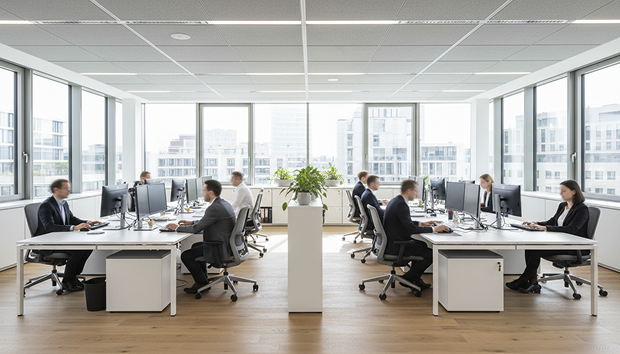
An open-concept office (or open-plan office) is a contiguous office area in which more than ten employees work in an open space without floor-to-ceiling walls. It differs from a cubicle office in its open structure and from purely open-space areas in that it has clearly defined functional zones.
How does an open-concept office differ from a traditional office?
Office types can be classified based on how the space is divided. From cubicle offices with individual rooms to combination offices and open-concept offices, the openness of the space increases gradually.
A modern open-concept office combines open workspaces with activity zones—areas each designed for a specific task. It is precisely this zoning that distinguishes this well-thought-out concept from a simple desk arrangement.
For hybrid teams, an open floor plan makes particular sense. When part of your workforce is working from home, shared workspaces allow for much more efficient use of space than permanently assigned individual offices.
What are the pros and cons of open-concept offices?
Open-concept offices offer short lines of communication and high space efficiency, but their main drawbacks are noise and a lack of private spaces. The balance between these two factors determines whether the space is productive or stressful.
What are the advantages of an open-concept office?
The advantages of an open-concept office lie in collaboration and cost savings. Teams can easily coordinate with one another; these discussions take place without the need to schedule appointments, and new employees are able to integrate more quickly.
Added to this is the financial benefit. An open-concept office with shared workstations significantly reduces per-capita office costs, especially in companies where a high percentage of employees work from home.
What are the disadvantages of an open-concept office?
The biggest drawback of open-concept offices is the noise level. Conversations, phone calls, and keyboard clicks all blend together, and it is precisely this acoustic distraction that is one of the most common reasons why concentration suffers in an open-concept office.
In a controlled laboratory experiment, a research team at Bond University demonstrated that typical open-concept office noise increases negative mood by 25% and the physical stress response by 34%—as measured by heart rate and skin conductance—after just eight minutes of noise exposure. In real-world office settings, where employees are exposed to these noise levels for hours on end, these effects are correspondingly more pronounced. (Sander et al., Journal of Management & Organization, 2021)
Open-concept office layouts also significantly reduce face-to-face communication. In two field studies conducted with Fortune 500 companies, the volume of face-to-face interaction dropped by about 70% after the transition to an open-concept layout, while email and instant messaging traffic increased sharply. People who are constantly visible to everyone tend to withdraw inwardly and turn to digital channels. (Bernstein & Turban, Philosophical Transactions of the Royal Society B, Harvard Business School, 2018). The availability of private spaces is therefore an important factor in well-being.
How do I design a modern open-concept office?
A productive and employee-friendly open-concept office is created through spatial zoning based on activity, effective soundproofing, and space planning based on actual usage data. However, furniture and rules alone are not enough if the basic layout of the space does not suit the way people work.
How does zoning work in an open-concept office?
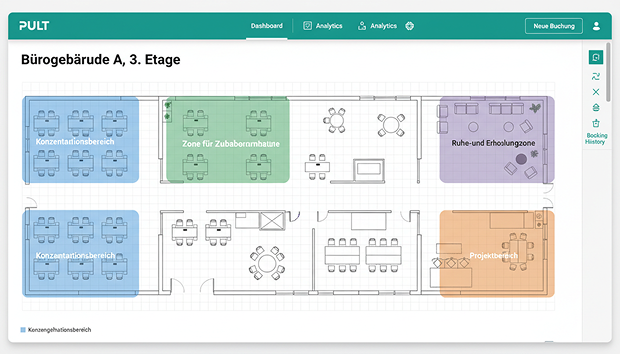
Zoning divides the open space into areas for different activities. This principle stems from the activity-based working concept, in which each type of work is assigned its own appropriate space:
This allows employees to choose a workspace that suits their current task and ensures they have the best possible conditions there.
What type of soundproofing is suitable for an open-concept office?
Effective soundproofing in an open-concept office is achieved through sound-absorbing materials and physical barriers. The combination of elements on the ceiling, on the floor, as well as room dividers and large plants reduces the noise level.
Acoustic panels on the ceiling and walls, sound-absorbing carpeting and rugs, and enclosed phone booths for video calls significantly reduce noise levels.
In cases where noise levels remain high despite these measures, the cause usually lies in the use of the space itself.
How does Desk Booking help optimize space in an open-concept office?
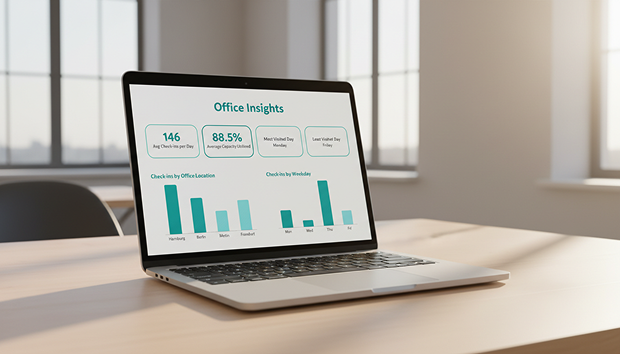
Desk Booking provides the data needed to plan an open-concept office according to actual needs. Rather than relying on assumptions, booking and occupancy data show which areas are regularly in use and which, by contrast, remain empty.
This leads to specific ways to adapt the space that allow for the redistribution and management of its use. For example, if the area designated for quiet work is consistently overbooked while spaces for collaboration remain empty, this is a measurable indicator that the layout needs to be redesigned.
PULT provides the necessary occupancy data: This allows you to analyze the use of your office space, and employees can reserve their seats in the appropriate zone.
How to Turn Your Open-Concept Office Into a Productive Workplace
An open-concept office becomes productive through zoning based on activity, effective soundproofing, and space planning based on actual usage data. The open space is preserved, and its weaknesses are eliminated through the right structure.
{{onpage-cta}}
.png)
%20(1).png)
.png)

.png)
