Blog

Workplace operations insights

Practical guides for office managers building better hybrid workplaces. Learn how to optimize space utilization, automate operations, and support distributed teams.

Get workplace operations insights in your inbox

Subscribe for monthly guides on hybrid work management, space optimization, and workplace automation.

Oops! Something went wrong while submitting the form.
Office Insights

Open-Concept Office: Pros and cons, design, and modern concepts

An open-concept office is an open workspace where many employees work together without partition walls. Noise, a lack of private spaces, and constant interruptions are considered the biggest drawbacks of open-concept offices. However, you can solve these very problems through zoning, well-designed soundproofing, and skillful space planning.

Open-concept Office: The Most Important Points at a Glance

An open-concept office refers to an open workspace for multiple teams without fixed partitions and is one of the most common office concepts in companies that adopt a hybrid work model.

The biggest drawback of open-concept offices is the noise level: noise and acoustic distractions are among the most commonly cited causes of loss of concentration and declining productivity in open-concept offices.

Zoning, acoustic partitions, and sound-absorbing materials solve the core problems in open-concept offices because they physically separate areas for concentration, communication, and relaxation.

PULT makes it possible to plan open-concept offices: Through Desk Booking and Office Insights, the software shows which zones are actually being used and provides occupancy data for space planning tailored to actual needs.

What is an open-concept office?

An open-concept office (or open-plan office) is a contiguous office area in which more than ten employees work in an open space without floor-to-ceiling walls. It differs from a cubicle office in its open structure and from purely open-space areas in that it has clearly defined functional zones.
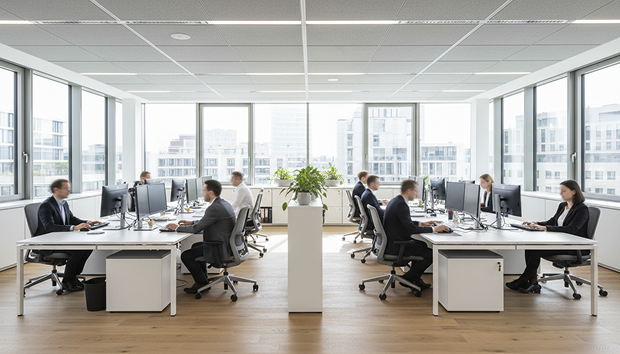
How does an open-concept office differ from a traditional office?

Office types can be classified based on how the space is divided. From cubicle offices with individual rooms to combination offices and open-concept offices, the openness of the space increases gradually.

A modern open-concept office combines open workspaces with activity zones—areas each designed for a specific task. It is precisely this zoning that distinguishes this well-thought-out concept from a simple desk arrangement.

For hybrid teams, an open floor plan makes particular sense. When part of your workforce is working from home, shared workspaces allow for much more efficient use of space than permanently assigned individual offices.

What are the pros and cons of open-concept offices?

Open-concept offices offer short lines of communication and high space efficiency, but their main drawbacks are noise and a lack of private spaces. The balance between these two factors determines whether the space is productive or stressful.

What are the advantages of an open-concept office?

The advantages of an open-concept office lie in collaboration and cost savings. Teams can easily coordinate with one another; these discussions take place without the need to schedule appointments, and new employees are able to integrate more quickly.

Added to this is the financial benefit. An open-concept office with shared workstations significantly reduces per-capita office costs, especially in companies where a high percentage of employees work from home.

Short lines of communication: Teams coordinate with one another without organizational hurdles.

Greater space efficiency: Shared workstations reduce costs per employee.

Greater transparency and visibility: You can immediately see who is present and what people are working on.

Faster onboarding: New colleagues learn the processes by working closely with the team.

What are the disadvantages of an open-concept office?

The biggest drawback of open-concept offices is the noise level. Conversations, phone calls, and keyboard clicks all blend together, and it is precisely this acoustic distraction that is one of the most common reasons why concentration suffers in an open-concept office.

In a controlled laboratory experiment, a research team at Bond University demonstrated that typical open-concept office noise increases negative mood by 25% and the physical stress response by 34%—as measured by heart rate and skin conductance—after just eight minutes of noise exposure. In real-world office settings, where employees are exposed to these noise levels for hours on end, these effects are correspondingly more pronounced. (Sander et al., Journal of Management & Organization, 2021)

Open-concept office layouts also significantly reduce face-to-face communication. In two field studies conducted with Fortune 500 companies, the volume of face-to-face interaction dropped by about 70% after the transition to an open-concept layout, while email and instant messaging traffic increased sharply. People who are constantly visible to everyone tend to withdraw inwardly and turn to digital channels. (Bernstein & Turban, Philosophical Transactions of the Royal Society B, Harvard Business School, 2018). The availability of private spaces is therefore an important factor in well-being.

How do I design a modern open-concept office?

A productive and employee-friendly open-concept office is created through spatial zoning based on activity, effective soundproofing, and space planning based on actual usage data. However, furniture and rules alone are not enough if the basic layout of the space does not suit the way people work.
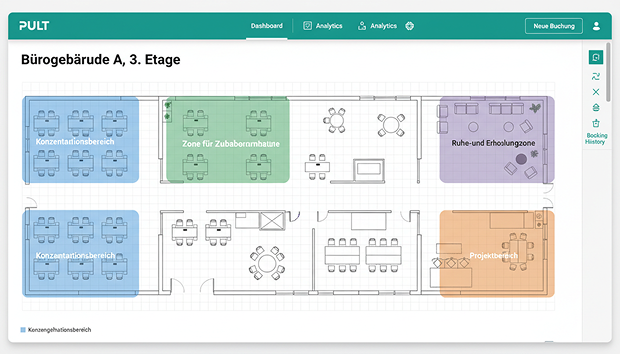
How does zoning work in an open-concept office?

Zoning divides the open space into areas for different activities. This principle stems from the activity-based working concept, in which each type of work is assigned its own appropriate space:

Quiet areas for concentration and quiet, independent work.

Opportunities for collaboration.

Customizable project areas for teamwork and time-bound projects.

Quiet, secluded areas for breaks and relaxation.

This allows employees to choose a workspace that suits their current task and ensures they have the best possible conditions there.

What type of soundproofing is suitable for an open-concept office?

Effective soundproofing in an open-concept office is achieved through sound-absorbing materials and physical barriers. The combination of elements on the ceiling, on the floor, as well as room dividers and large plants reduces the noise level.

Acoustic partitions between workstations block sound directly at the source.

Large plants with lush foliage also act as natural sound barriers.

Upholstered furniture and upholstered room dividers absorb sound.

Floor-to-ceiling partitions in an open-concept office separate zones from one another both acoustically and visually.

Acoustic panels on the ceiling and walls, sound-absorbing carpeting and rugs, and enclosed phone booths for video calls significantly reduce noise levels.

In cases where noise levels remain high despite these measures, the cause usually lies in the use of the space itself.

How does Desk Booking help optimize space in an open-concept office?

Desk Booking provides the data needed to plan an open-concept office according to actual needs. Rather than relying on assumptions, booking and occupancy data show which areas are regularly in use and which, by contrast, remain empty.

This leads to specific ways to adapt the space that allow for the redistribution and management of its use. For example, if the area designated for quiet work is consistently overbooked while spaces for collaboration remain empty, this is a measurable indicator that the layout needs to be redesigned.

PULT provides the necessary occupancy data: This allows you to analyze the use of your office space, and employees can reserve their seats in the appropriate zone.
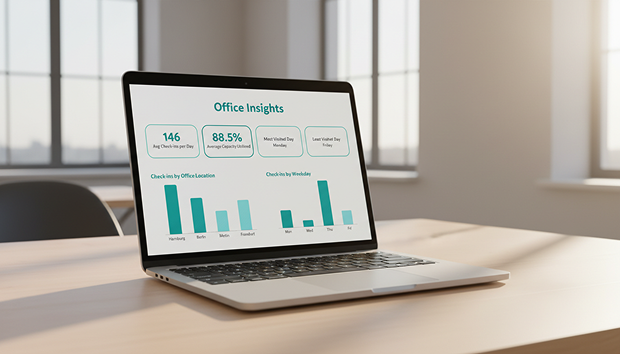
How to Turn Your Open-Concept Office Into a Productive Workplace

An open-concept office becomes productive through zoning based on activity, effective soundproofing, and space planning based on actual usage data. The open space is preserved, and its weaknesses are eliminated through the right structure.

With PULT Office Insights, you can see which areas of your space are actually being used and plan renovations based on real data.

Your employees can reserve a workspace in the appropriate zone and see where their colleagues are already seated.

You manage capacity and attendance all in one place.

{{onpage-cta}}

Office Insights

Workplace Automation: What does it really mean for your office?

Workplace automation refers to the automation of daily, recurring office tasks, from desk reservations to visitor registration. For companies with a hybrid work model, the question arises as to which processes can be automated and how this can be done in compliance with the GDPR.

Workplace Automation: The Basics

Workplace Automation automates recurring office processes—such as room and desk reservations, attendance tracking, and visitor management—based on rules, without requiring employees to manually initiate each step.

You can identify office processes that are ready for automation by three characteristics: clearly definable rules, a high frequency of repetition, and a measurable susceptibility to errors when processed manually.

SMEs must ensure compliance with three requirements before launching: GDPR-compliant data storage, involvement of the works council (Section 87 of the Works Constitution Act), and adherence to EU hosting standards to avoid issues related to the Cloud Act.

PULT is an all-in-one office management platform that automates desk booking, room reservations, office analytics, and visitor management, and integrates fully with MS Teams, Personio, and Slack so your office runs without any manual intervention.

What is workplace automation

Workplace automation encompasses all software-driven office processes in which a defined rule or algorithm determines the next step.

This ranges from automatic booking confirmations to rescheduling meeting rooms when the number of participants does not match the room size. In this way, workplace automation goes beyond mere digitization measures. Digitization converts paper forms into machine-readable data. Automation handles the resulting tasks on its own.

Which office processes can be automated?

Processes that occur daily and always follow the same or a similar pattern are ready for automation.

Area Manual Process Automated version
Space & Workplace Booking meeting rooms, spaces, and workstations by arrangement, via a list, or by email. Self-booking with automatic confirmation
Space & Workplace Identifying and Resolving Duplicate Bookings Automatic detection and rebooking in the event of capacity conflicts
Space & Workplace Send a reminder for your own desk reservation Automatic push notification to the user
Space & Workplace Coordinate Parking Assignments Using a Spreadsheet Automatic assignment of parking spaces based on predefined booking rules
Visitor Management Visitor Registration at the Front Desk Paperless Self-Registration with GDPR-Compliant Data Collection
Visitor Management Notify the host by phone when visitors are arriving Automatic notifications via MS Teams or Slack
Office Evaluation Track Office Utilization Using Handouts Real-Time Analysis of Office Usage
Office Evaluation Compile capacity utilization reports yourself Automatically generated reports based on occupancy data
Human Resources Management Manage Leave Requests via Email Automated approval process with status notifications
Human Resources Management Create and Send Onboarding Checklists Automated task assignment and access granting upon admission
Attendance & Planning Who is in the office and when? Check with them to find out. Real-Time Automatic Attendance Overview
Attendance & Planning Coordinate office days with the team via chat Rule-Based Scheduling with Attendance Thresholds
IT & Access Manually Set Up Access for New Employees Automatic Assignment of Permissions via SSO and HR Integration
IT & Access Access Control by Reception Staff Automated access control via app or badge
Buildings & Facilities Cleaning schedules based on a fixed weekly plan Cleaning Based on Actual Room Usage
Compliance & Security Manually Maintain Attendance Lists for Fire Safety Real-time occupancy data as the basis for evacuation plans

How does automated room and desk booking work?

For example, an automated meeting room management system detects when two people book a conference room that is actually designed to accommodate 20 people. The system identifies the discrepancy and automatically rebooks the reservation into a smaller, suitable room.

This reduces the number of conflicts over available spaces and frees up time for office managers that was previously spent on manual adjustments. Workplace automation via Wi-Fi check-in takes this a step further: As soon as you log in to the office with your device, the system automatically reserves your desk without a single click.

What compliance considerations must a company keep in mind when implementing workplace automation?

Automating office processes always involves processing data. Therefore, three points must be clarified:

GDPR Compliance: What data does the tool collect, how long is it stored, and who has access to it? Booking data and attendance records are considered personal data.

Employee Participation: As soon as a tool tracks attendance or workload, Section 87(1)(6) of the Works Constitution Act (BetrVG) applies. You must consult with the works council before implementing it.

Hosting: EU hosting with a German or European data center circumvents the Cloud Act issues that arise with U.S. providers without an EU branch.

How do I get started with Workplace Automation?

To automate your workplace, start by identifying all the processes that, although they follow a very consistent pattern, are repeatedly carried out manually by employees. Review these processes and provide your team with software to automate them. The more processes a single software solution can handle, the fewer new tools you'll need to burden your team with.

1

Identify processes: Which processes take more than 30 minutes each day or regularly produce errors? These are the first candidates.

2

Examine the process: Is the current process already the best option? Or could it be streamlined?

3

Select a tool based on its integration capabilities: EU hosting and integration with existing systems are important selection criteria.

4

Roll out the changes gradually: Start with one feature—such as automatic room booking—and then expand to other areas after receiving positive feedback.

5

Review KPIs after 4 weeks: How many booking conflicts remained? How much administrative time was saved? How has office utilization changed?

Here's how PULT puts your office management on autopilot

Your workplace automations work best when they're bundled into a single software solution rather than spread across multiple tools. You can bundle workstation and room reservations, presence detection, occupancy analysis, visitor management, and parking management into PULT:

Desk booking, room booking, and office analytics are all handled in a single tool, without any integration issues between individual systems.

Automatic presence detection via your existing Wi-Fi system.

Office Insights provide data and analyses on office utilization.

Full integration with MS Teams, Slack, Personio, and HiBob.

{{onpage-cta}}

Office Insights

Huddle Meetings: How to make daily team check-ins truly productive

A huddle meeting is a daily or regular team check-in that takes no more than 15 minutes to align priorities and identify roadblocks. The difference from a traditional status meeting lies in its structure and in what you consistently leave out afterward.

Huddle Meeting: The Basics

A huddle meeting is a regular team check-in limited to 10 to 15 minutes, with three set questions: What was completed yesterday? What's on the agenda for today? What's currently holding the team back?

The Daily Huddle meeting format works whether held in person or virtually, without an agenda document and with a rotating spokesperson. Anything that goes beyond the three core questions should be addressed in follow-up discussions afterward.

For hybrid teams, team huddle meetings require some ground rules: cameras on, a fixed time zone, a breakout channel for follow-up discussions, and GDPR-compliant policies for recording.

PULT, the all-in-one software for hybrid office management, shows moderators in real time every day who is in the office and who is working remotely. This provides a reliable information basis for every huddle meeting before it begins.

What is a huddle meeting?

A huddle meeting is a short, structured team discussion of a fixed duration (10 to 15 minutes) that takes place daily. The goal is to coordinate efforts. Discussions should be held in separate follow-up meetings. Each team member answers the same three questions:

1

What did I finish yesterday?

2

What do I have to do today?

3

What's holding me back right now?

The concept originates from Scrum, where the daily huddle is known as the daily standup. It is now also used by HR, operations, and sales teams, as well as cross-functional teams that coordinate across locations.

What is the proper format for a huddle meeting?

The huddle meeting format requires three key conditions to be effective: strict adherence to the schedule, the assignment of a facilitator, and a fixed list of participants.

1

Duration and Timing. The Daily Huddle Meeting takes place at the same time every day. Exceptions weaken the routine. The maximum duration is 15 minutes. If you regularly go over that time, you should consider whether parts of the content belong in a separate format.

2

Participants. Only individuals who are directly dependent on one another. Larger departments are divided into smaller subgroups.

3

Facilitator's Role. A facilitator keeps track of time and consistently directs discussions toward follow-up conversations. Rotating facilitation fosters a sense of personal responsibility within the team.

Element Standard Remote/Hybrid
Duration 10 to 15 min. 10 to 15 min.
Format While standing Camera on
Moderation Rotating Specified
Follow-up meetings Right after that Breakout Channel
Minutes Optional Note Short Chat Log

What changes in the team huddle meeting in a hybrid office?

In teams where some members are in the office and others are working remotely, three issues arise that could undermine the format: remote participants become passive listeners, discussions in the plenary session get out of hand, or technical problems delay or prolong the meeting.

Checklist for Hybrid Team Huddle Meetings:

Cameras are required for all participants, including office groups sharing a screen.

Real-time chat in the team chat during the meeting.

Breakout session or a fixed time slot on the calendar for follow-up meetings immediately afterward.

A fixed meeting link and time zone in everyone's calendar.

Facilitating from a remote setting to ensure that remote participants are on an equal footing in terms of structure.

Clear hybrid work policies are essential for this model to work for everyone involved.

What legal considerations must companies keep in mind during their daily huddle meetings?

Daily huddle meetings count as work time and must be documented as part of time tracking. This also applies to brief 10-minute check-ins.

If you record video huddles, you need a GDPR-compliant legal basis and must inform participants in advance. If the huddle format is used for regular performance monitoring, a company agreement may also be required.

How to Make Huddle Meetings a Permanent Part of Your Hybrid Team

A huddle meeting is only effective when time management, structure, and the facilitator's role work together seamlessly. In a hybrid work environment, a fourth factor comes into play: transparency about who is working, when, and from where. Daily check-ins help to improve the employee experience because coordination routines become reliable and transparent for everyone.

Use PULT to see where your colleagues are working

PULT shows you at any time who is in the office and who is working remotely. You can also see your colleagues' scheduled attendance and receive reports on your teams' attendance. Desk booking, room booking, visitor management, and office insights are all integrated into a single platform.

{{onpage-cta}}

Desk Booking

Office Organization: Filing systems, methods, and tools for smooth office operations

Office organization encompasses the structure of your workspaces, your filing system, and your workflows. It ensures that documents, desks, and meeting rooms are used as intended without the need for daily supervision. To keep this system running smoothly within your team—and prevent it from falling apart after just three days—you need rules, appropriate filing systems, and tools that can adapt to the evolving nature of hybrid work.

Office Organization: The Basics

Office organization consists of three levels: the physical workplace layout (desks, filing, labeling), the computer-based filing systems, and the processes that determine who files or enters what and when.

Traditional scheduling and filing systems fall short in a hybrid work environment because they do not manage either desk occupancy or meeting room usage.

Hybrid work shifts the focus of office organization from simple filing to space planning, attendance coordination, and booking shared workstations.

PULT combines these tasks into an all-in-one office management software solution featuring desk booking, room booking, and office insights, allowing office managers to manage desks, rooms, and utilization all in one place.

What does office organization involve?

Office organization encompasses the physical layout of the workspace, filing systems, and day-to-day office procedures. It addresses three things at once: where documents are stored, how workstations are assigned, and the rules by which the team operates. A well-organized office runs smoothly over the long term without the need for daily reminders.

Most attempts at office organization fail because they lack sustainability. Checklists and reminders work for a few days, but then the old habits return. The reason: A rule without a system always depends on the discipline of each individual. A system, on the other hand, maintains order on its own because it specifies where things belong and who is responsible for them.

How do I set up an effective filing system in the office?

An effective filing system organizes documents according to a single, clearly defined principle. Three systems have proven effective:

1

Alphabetical. For customer or supplier files with unique names.

2

Chronologically. For ongoing processes such as invoices or minutes.

3

By topic. For projects and subject areas with fixed categories.

The clean desk policy also forms the basis for a sustainable filing system. If every desk is cleared at the end of the workday and every document has a designated place, those piles of paper that later become impossible to trace back to anyone never accumulate in the first place.

Label each folder and compartment clearly, and establish a rule for who puts documents back in their proper place. These three points will keep your filing system organized, even as your team grows.

What filing systems are suitable for everyday office work on the computer?

To organize your files on your computer, you need a flat folder structure with clear naming conventions. Deep nesting, on the other hand, tends to waste time and leads to duplicate files. Three rules will help keep your structure clean:

1

Naming convention. Date first in the format YYYY-MM-DD, followed by the project, then the document type.

2

Depth. A maximum of three levels, so that every file can be accessed in fewer than three clicks.

3

Access. Assign permissions on a per-folder basis so it's clear who is allowed to save and edit files.

The division between paper and computer is as follows:

Original, signed contracts and documents subject to legal retention requirements must be physically stored in the archive.

All operational documents—such as minutes, drafts, and correspondence—are stored on the computer because multiple people access them at the same time.

How is hybrid work changing the way offices are organized?

Hybrid work shifts the focus of office organization from filing to space and attendance planning. As soon as part of your team isn’t on-site every day, desks sit empty, meeting rooms are booked remotely for the coming days, and no one knows for sure who will be in the office on a given weekday. Office organization thus directly impacts the daily planning of the entire team.

How do I organize desk sharing and meeting rooms in a hybrid office?

Shared workspaces only work if there are established booking rules. Without them, you’ll run into exactly the kinds of friction you’d most likely want to avoid: disputes over desks and meeting rooms that are either overcrowded or booked but empty. The foundation is laid by binding rules for workspace sharing, which specify how long a desk remains reserved and what happens at the end of the day.

When it comes to meeting rooms, the problem usually lies in the booking process itself. A large room is reserved for just two people, while a small one is overbooked. Automated meeting room management solves this by checking bookings and rebooking them as needed.

Let AI automatically optimize your meeting rooms

Manually managing meeting rooms can easily take more than 15 hours a week. The PULT AI Room Agent identifies inefficient bookings, suggests more suitable meeting rooms, and automatically releases rooms if no one shows up.

Learn how to book a room in PULT

How do I organize my office when employees are also working from home?

If you want to organize your office while part of the team is working from home, you need constant coordination between both locations.

Once current and planned availability is visible to the team regardless of location, desks, meetings, and handoffs can be scheduled without everyone having to check with each other individually.

Systematic Office Organization: How to Keep Your Daily Office Routine Running Smoothly

Office organization requires clear rules for shared workspaces and a planning system that provides visibility into attendance and space utilization. PULT automatically detects your colleagues’ presence, enables your team to plan and book in advance, and helps ensure that all resources are allocated fairly:

1

You can book desks and meeting rooms and put an end to the arguments over available spaces.

2

With Office Insights, you can see how busy your office is and plan your space based on actual data.

3

You integrate the booking into MS Teams or Slack so your team doesn't have to open a separate program.

4

You'll keep track of who's on-site and when, and plan hybrid weeks without having to constantly ask around.

{{onpage-cta}}

Office Insights

The Paperless Office: A step-by-step guide from piles of paper to a digital workflow

The paperless office describes an ideal state in which documents, approvals, and internal processes are handled without a parallel analog system. However, many attempts at digitization result in duplicate records, a situation that can be avoided.

The Paperless Office: The Basics

A paperless office can only be achieved when processes and documents are transformed together. However, parallel structures undermine both the concept and the benefits.

For legally compliant archiving in accordance with GoBD, retention periods of 6 and 10 years apply. Digitally archived documents must be stored in a manner that ensures they are complete, unalterable, and can be reconstructed at any time for audit purposes.

Implementing a paperless office: Assess the current situation, prioritize appropriate processes, select software, involve the team, and evaluate the results after 90 days.

PULT digitizes room reservations, desk bookings, and visitor management in a completely paperless manner and integrates directly with MS Teams, Slack, Personio, and HiBob—as part of a paperless office management system.

What distinguishes a truly paperless office from a digital filing system?

Going paperless starts with ensuring that a process—such as approving a vacation request or processing an incoming invoice—runs from start to finish without any physical documents. If, on the other hand, you simply scan a document and forward the PDF via email, you’ve eliminated the paper, but not the process.

Document vs. Process: What's the Difference?

Document digitization converts a paper document into a file. Process digitization redesigns the workflow behind it: Who submits the request, and where? Who approves it, and how? Where is the result stored in an audit-proof manner and immediately retrievable? Only when both are combined can a paperless office without parallel structures be achieved.

What aspects of office work can be made paperless?

As a general rule, almost all processes that have been handled on paper up to now can be digitized:

Inbox: digital inbox with automated forwarding.

Invoice Processing: Digital Incoming Invoices with Accounting Integration.

Contracts and Documents: DMS with full-text search and access rights.

HR documents: digital personnel file, electronic time tracking.

Visitor Management: Digital check-in processes instead of paper lists, as with visitor management using PULT.

Room and desk reservations: Reservation systems instead of notice boards and in-person reservation arrangements.

Digital booking of rooms and seats in PULT, with automatic check-in and AI-powered meeting room management.

What legal considerations do I need to keep in mind when setting up a paperless office?

The key legal pillars of the paperless office in Germany are the GoBD, document retention periods, and the e-invoicing requirement.

GoBD and Audit-Compliant Archiving

A digitally archived document is considered GoBD-compliant if it meets three principles:

Completeness: No document may be missing or deleted without verification.

Immutability: Subsequent changes must be prevented or fully logged.

Traceability: Every access can be reconstructed by auditors.

Retention periods apply regardless of format: 10 years for accounting documents, balance sheets, and tax-related business correspondence; 6 years for other business correspondence. A GoBD-certified document management system (DMS) then technically implements these requirements.

E-Invoicing and Other Digitalization Requirements

Starting in January 2025, all B2B companies in Germany must be able to receive e-invoices. The requirement to send e-invoices will take effect in 2027 for companies with annual revenue exceeding 800,000 euros, and in 2028 for all companies.

Beforehand, the general processing of invoices should already be fully digitized so that the transition to e-invoicing can then be made with comparable ease.

What software do I need for a paperless office?

Setting up the right software infrastructure for a paperless office means making a decision for each category and finding the best tools for hybrid work for the company. Four categories cover the majority of paper-related processes:

Category Tools (Examples) What is it for?
Document Capture & DMS DocuWare, ELO, M-Files Audit-compliant archiving, full-text search, access rights
Digital Signature Skribble, DocuSign Legally valid signature without a printout
Invoice Processing DATEV, Lexware, Candis Incoming invoices, accounting integration
Office Management PULT Room booking, desk booking, visitor management, and parking management, integrated with Microsoft Teams, Slack, and HR systems

{{onpage-cta}}

How do I implement a paperless office step by step?

To move toward a paperless office, first map out the processes taking place in your office, review and streamline the most important ones, select the appropriate software, and then work with your team to implement the now-digital process.

1

Assess the current situation. Document all paper-based processes, including the steps involved: who does what, when, and using what medium?

2

Prioritize processes. Start with the area that offers the greatest time savings. This typically involves incoming invoices or HR processes, as they are time-consuming and prone to errors.

3

Consolidate your tool stack. A few comprehensive platforms are better than a multitude of individual tools, because data interfaces remain the most common source of errors. Choose tools that communicate with each other.

4

Involve the team before rolling out the tool. Employees won't use tools they know nothing about and don't see as benefiting them personally.

5

Evaluate after 90 days. What usage rates have the tools achieved? Where are there still media breaks? What needs to be revised?

How to Keep Your Office Paperless for the Long Term

Your employees will follow the digital processes as long as there is no reason to deviate from them. Therefore, the processes—and especially the software—in the paperless office must offer them everything that was previously possible on paper and even go beyond that.

With PULT, you can manage all aspects of your office operations: room reservations and automated meeting room management, presence detection, office usage analytics, visitor reception, and more:

{{onpage-cta}}